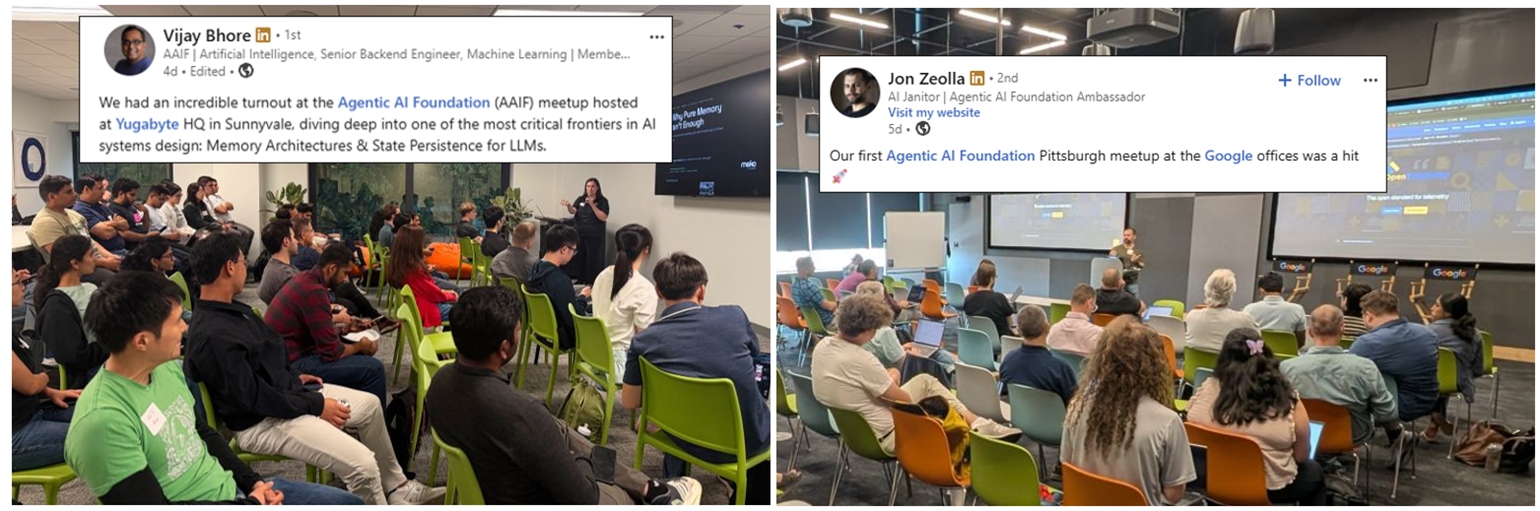
I love seeing how much is happening across the AAIF community. Sunnyvale heard talks on memory architectures and state persistence for agents, while Pittsburgh went hands-on building and testing an MCP server from scratch. There’s plenty more on the calendar too, with local meetups and virtual sessions coming up. Check out the events section to see what’s happening near you, or what you can join online. |
HIT REPLY “What’s one repo you think deserves more love?” Reply to this email - we read every one. |
In case you missed it GemsACP for cloud-based coding agents Looking at ACP as a control layer for remote coding agents, with networked runners, editor support, and abstraction between agent execution, harnesses, and models. Coding agent completion framework Using acceptance gates, runnable checks, and re-verification, Unlazy helps coding agents validate completed work before reporting success. LLM documentation compression prototype Testing compressed documentation against generated questions, GitHub Next’s prototype cuts token usage while checking that the knowledge remains usable by LLMs. Visual explanation skill for coding agents Using component trees, call stacks, diagrams, file layouts, pseudocode, and HTML, show-me gives coding agents compact ways to explain code structure, planned changes, and large diffs. |
LIVE + INTERACTIVE - LUNCH AND LEARN Where are coding agents breaking?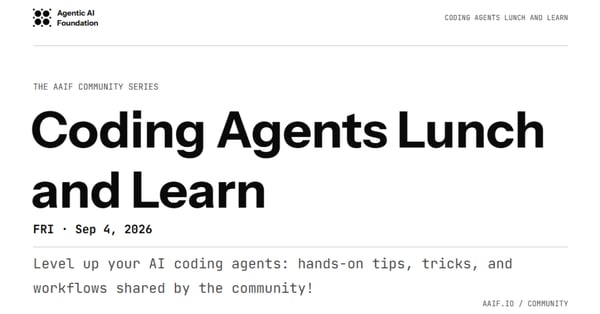 What can the Hugging Face security incident teach us about the risks emerging around coding agents? Ads Dawson from Dreadnode joins this week’s Lunch & Learn to unpack what happened, the vulnerabilities builders should be paying attention to, and what he’s seeing across agent security right now. Then it opens up to the room. Bring a question, share something you’ve run into, or just listen in as the conversation goes wherever the useful stuff is. Friday, September 4 · 9 AM PT / 6 PM CEST REGISTER NOW Can’t make that time? We’re expanding Lunch & Learns across US, EU, and APAC-friendly sessions, so keep an eye out for more dates and times. |
AAIF COMMUNITY The MLOps adventure continues: An AGENTS.md ready stack for AI/MLRemoving 900+ lines of config while doubling static checks sounds backwards, but it came from giving AI coding agents fewer places to get confused. The redesign centers on deterministic repository feedback: one canonical gate, executable guardrails, and isolated test state. - One gate:
mise run all now drives local workflows, git hooks, CI, and agent instructions, removing duplicated command lists that had silently drifted. - Fast isolation: copying a pre-migrated SQLite template cut MLflow test overhead by about 60% after migrations had pushed runtime from 34 to 339 seconds.
- Executable rules:
AGENTS.md guides behavior, while tests, linters, and dependency checks verify that commands, paths, and security overrides still hold.
The core lesson is that agents work best when repository rules produce one clear, repeatable source of truth. Read the blog |
Improving tool-call reliability with JSON Schema 2020-12A $12,500 transfer missing one approval field can either trigger an opaque failure or a precise, repairable error before the ledger is touched. JSON Schema 2020-12 gives MCP tools a stronger way to encode those rules directly into the contract rather than leaving them in descriptions. - Conditional validation:
if/then, oneOf, and $defs can enforce state-dependent requirements and prevent incompatible argument combinations. - Clearer recovery: schema failures can return field-specific invalid-params errors that an orchestrator repairs within a bounded retry loop.
- Layered enforcement: validation happens before business logic, while the underlying service still keeps final authority over business rules.
The key design shift is treating tool schemas as executable API contracts that tell agents what can be fixed and what should stop. Read the blog |
A2A v1.0: a builder's guide, part 2 - migration, security, and productionA2A v1.0 changed enough on the wire that a 0.3 parser can break even when the task flow looks familiar. The migration also introduces important changes around bindings, durable tasks, agent-card verification, and authorization. - Breaking changes:
kind discriminators are gone, enums changed, and ProtoJSON is now the canonical serialization. - Durability:
ListTasks, database-backed stores, and persistent webhooks help work survive lost IDs, disconnects, and restarts. - Security: signed agent cards protect endpoint integrity, while
AUTH_REQUIRED supports controlled approval and credential escalation.
The practical takeaway is how to migrate A2A systems while preserving compatibility, security boundaries, and durable task behavior. Read the blog |
|
Come and connect IN-PERSON EVENTSFind your city here, or start a chapter if there isn't one yet. |
Join from anywhere VIRTUAL EVENTS |
MEME OF THE WEEK 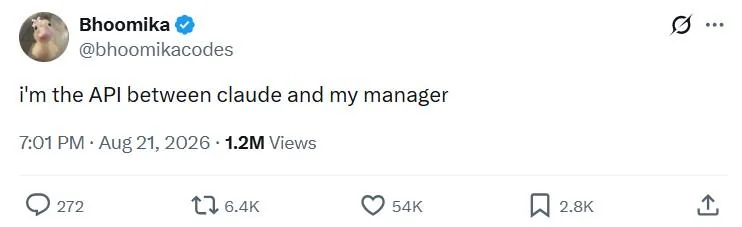 |
Sent by Demetrios Brinkmann on behalf of Agentic AI Foundation (AAIF). The Linux Foundation, 2810 N Church St., PMB 57274, Wilmington, Delaware 19802-4447, United States |
|
|